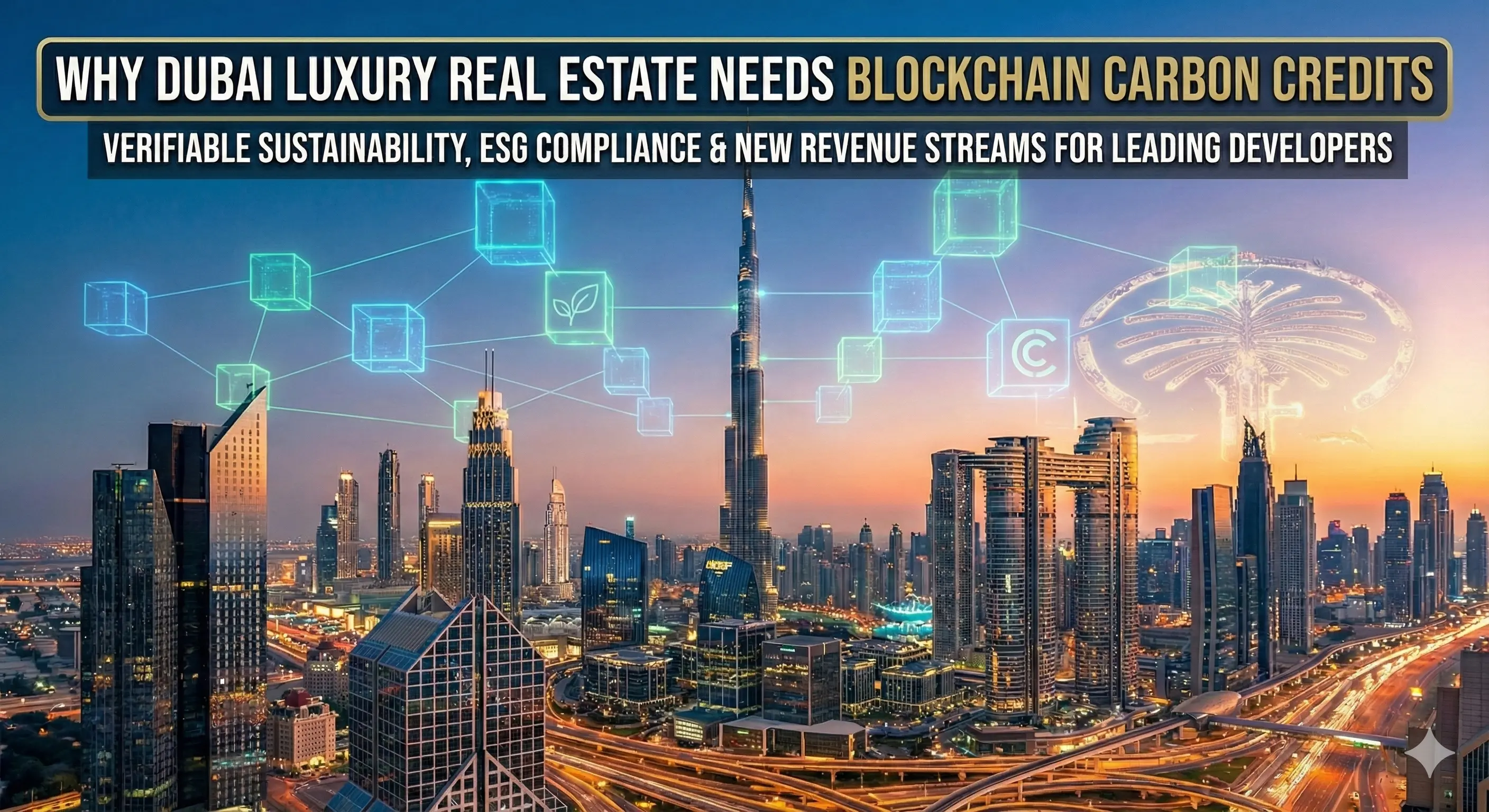
The Problem: Unverifiable Sustainability Claims in Luxury Real Estate
When a Dubai resident recycles a bottle, walks instead of drives, or refills a shampoo container, they’re making a choice. But in 2025, that choice still disappears into an opaque system of points, unverifiable claims, and goodwill that generates zero institutional value.
Meanwhile, luxury real estate developers spend millions on sustainability features that can’t be proven, tracked, or monetized beyond marketing brochures. This disconnect represents one of the most significant missed opportunities in modern PropTech, and blockchain carbon credits are the solution hiding in plain sight.
The Credibility Gap in Green Real Estate
Dubai has committed to reducing carbon emissions by 30% by 2030 under its Net Zero Carbon Strategy. The emirate’s regulatory environment, anchored by frameworks like VARA (Virtual Assets Regulatory Authority), has created one of the world’s most forward-thinking jurisdictions for digital asset innovation.
Yet the real estate sector, which accounts for nearly 40% of global carbon emissions, still relies on self-reported data, annual audits, and static certifications that fail to capture real-time impact.
Luxury developers like Fakhruddin Properties invest heavily in patented green technologies:
- Smart air handling units that improve indoor air quality while reducing energy consumption
- Waste management systems that divert 85-90% of waste from landfills
- Refill stations that eliminate single-use plastics
These innovations are impressive. They’re also invisible to auditors, investors, and residents beyond the moment of installation.
The problem isn’t intention. It’s infrastructure. Without continuous, tamper-proof verification, sustainability claims remain exactly that: claims. And in an era where ESG-linked financing, carbon-conscious investors, and regulatory reporting standards are rapidly maturing, unverifiable impact is becoming a liability.
Why Blockchain Changes the Carbon Equation
Blockchain technology introduces something the real estate sector has never had: an immutable, transparent, and continuously updated ledger of environmental actions.
When a resident participates in a sustainable behavior—recycling, reducing energy consumption, participating in community wellness programs—that action can be recorded on-chain, timestamped, and linked to a verifiable carbon offset calculation.
Think of it as a bank statement for sustainability. Just as financial transactions are recorded, verified, and auditable, every kilogram of CO2 saved can be permanently logged on a blockchain. Auditors and regulators can see exactly how much carbon a property has offset at any given moment. More importantly, these records can’t be altered retroactively, edited by marketing teams, or lost in annual reporting cycles.
Three Key Advantages for Luxury Real Estate
This creates three immediate advantages for luxury real estate:
First, institutional trust. ESG investors, green bond issuers, and regulatory bodies can verify environmental claims in real-time rather than relying on annual reports or third-party audits conducted months after the fact. A blockchain-verified carbon reduction ledger becomes the gold standard for compliance and reporting.
Second, resident engagement at scale. Tokenizing carbon offsets transforms abstract environmental goals into tangible, gamified incentives. Residents aren’t just “doing their part.” They’re earning digital assets that have potential monetary value, can be redeemed for services, or may eventually be traded in carbon markets. This shifts sustainability from a moral obligation to an economic incentive, dramatically increasing participation rates.
Third, new revenue streams. As carbon markets mature and regulatory frameworks solidify, developers who have been continuously recording verified carbon reductions will be positioned to aggregate and monetize those offsets. A single luxury tower with 200 units could generate thousands of tons of verified CO2 reductions annually. These are offsets that could be bundled and sold to corporations seeking to meet net-zero commitments.
The Luxury Market Is Uniquely Positioned to Lead
Luxury real estate occupies a strategic position in this transformation. High-net-worth residents are more likely to be early adopters of digital assets, more responsive to ESG considerations, and more engaged with property-level innovation. They’re also willing to pay premiums for verifiable differentiation, and blockchain-verified carbon neutrality is the ultimate differentiation.
Breaking Through the Commoditization of Green Claims
Consider the competitive dynamics. In Dubai’s saturated luxury market, developers compete on finishes, amenities, and location. But these are increasingly commoditized. Smart home features are standard. Wellness amenities are expected. Even sustainability claims have become background noise because every developer makes them.
Blockchain carbon credits break through this noise by offering something competitors cannot easily replicate: mathematical proof.
A developer can claim their building is green. A developer with blockchain-verified carbon credits can prove it, down to the kilogram, updated in real-time, auditable by any stakeholder. That proof becomes a marketing asset, a financing advantage, and ultimately a premium pricing justification.
This isn’t theoretical. Studies show that properties with verified green certifications command 5-10% price premiums and experience faster sales cycles. Blockchain carbon credits represent the next evolution of that dynamic. They move from static certification to dynamic, continuous verification.
Technical Architecture for Real-World Impact
Implementing blockchain carbon credits in luxury real estate requires more than smart contracts and tokens. It demands integration with existing property management systems, careful UX design to ensure resident adoption, and privacy-preserving architecture that protects individual data while maintaining verification integrity.
The Technical Solution: Layer by Layer
The technical solution involves several layers:
Base Layer: A blockchain network (public testnets like Arbitrum or Base offer cost-effective, secure options) provides the immutable ledger.
Smart Contracts: Automate the issuance of carbon credit tokens based on verified behaviors:
- Recycling events logged via QR codes
- Energy reduction detected by smart meters
- Participation in wellness programs tracked through building apps
Wallet Abstraction: Layers like Privy or Pimlico ensure residents never need to understand blockchain mechanics. They interact with a familiar mobile app interface while, behind the scenes, their actions mint tokens to pseudonymous wallets.
Account Abstraction: Enables gasless transactions, removing friction and cost barriers.
Privacy and Compliance
Privacy is maintained through off-chain storage of personally identifiable information, with only anonymized action records and carbon calculations stored on-chain. This architecture complies with GDPR and UAE PDPL requirements while preserving the transparency benefits of blockchain verification.
The result is a system where residents experience a seamless, Web2-style interface. They check their token balance, redeem rewards, and track their carbon impact. Meanwhile, property managers and auditors access a real-time, verified ledger of aggregate environmental performance.
From Proof of Concept to Market Standard
Dubai’s regulatory clarity around digital assets, combined with its ambitious sustainability targets and concentration of luxury real estate development, creates ideal conditions for blockchain carbon credits to move from experimental technology to market standard.
The Path Forward for Early Movers
The path forward requires:
- Pilot programs that prove viability
- Partnerships between blockchain developers and established real estate players
- Collaborative engagement with regulatory bodies to establish verification standards
Early movers will capture strategic advantages:
- Resident data that informs carbon optimization strategies
- Proven technology infrastructure that can be licensed or franchised
- Brand positioning as true sustainability leaders rather than greenwashing followers
Three Converging Trends
More broadly, blockchain carbon credits represent a convergence of three major trends:
- The tokenization of real-world assets
- The maturation of carbon markets
- The increasing importance of verifiable ESG performance
Luxury real estate developers who recognize this convergence and act decisively will not only differentiate their properties. They’ll help build the infrastructure for a more transparent, accountable, and sustainable built environment.
Real-World Implementation: What Success Looks Like
Consider a luxury tower in Dubai Marina implementing blockchain carbon credits:
Month 1-3: Setup
- Install IoT sensors for energy monitoring
- Deploy smart waste bins with QR code scanning
- Launch resident mobile app with wallet integration
- Configure smart contracts for token issuance
Month 4-6: Pilot
- 100 early-adopter residents begin earning carbon credit tokens
- Track behavioral changes and engagement metrics
- Refine token economics based on actual participation
- Generate first verified carbon reduction reports
Month 7-12: Scale
- Expand to all 500+ units
- Aggregate sufficient carbon credits for first marketplace sale
- Present real-time dashboard to potential buyers and investors
- Submit blockchain-verified reports to regulators
Year 2: Maturity
- Generate recurring revenue from carbon credit sales
- Use verified sustainability data to secure green financing
- Command premium pricing for new units
- License technology to other developments
The Competitive Advantage Timeline
The question is no longer whether blockchain and carbon credits will transform real estate sustainability. The question is which developers will lead that transformation, and which will be left explaining why their environmental claims can’t be verified.
2025-2026: First-mover advantage
- Pilot programs establish technical proof
- Early brand positioning as innovation leaders
- Learning period for optimization
2027-2028: Market differentiation
- Verified carbon credits become expected by investors
- Premium pricing justified by mathematical proof
- Competitors scramble to catch up
2029-2030: Industry standard
- Regulatory frameworks mandate verifiable reporting
- Unverified claims face scrutiny
- Carbon credit revenue becomes standard project financing
The competitive advantage belongs to developers who can prove their sustainability claims with mathematical certainty. Those who can show regulators, investors, and residents a real-time ledger of carbon reductions. Those who turn environmental consciousness into economic value through tokenized incentives and carbon credit monetization.
The Time to Act Is Now
Blockchain carbon credits aren’t just a technological upgrade. They’re a strategic imperative for luxury real estate in Dubai and beyond.
The convergence of regulatory clarity, technical maturity, and market demand creates a narrow window for first-movers to establish dominant positions. Early adopters will set standards, capture data advantages, and build brand equity as authentic sustainability leaders.
The infrastructure exists. The market is ready. The competitive dynamics favor action.
The only question is: will you lead, or will you explain why you waited?
Transform Your Property Portfolio
Ready to explore how blockchain carbon credits could work for your property portfolio? Aunova specializes in building tokenized sustainability solutions for forward-thinking real estate developers.
With over 15 years of combined blockchain expertise and award-winning innovation across multiple Web3 ecosystems, we translate complex technology into elegant resident experiences and verifiable business value.
What we deliver:
- Proof-of-concept implementations tailored to your properties
- Integration with existing property management systems
- Resident engagement platforms that drive adoption
- Regulatory compliance frameworks
- Carbon credit aggregation and monetization strategies
Contact Aunova today to discuss a proof-of-concept for your development. Visit aunova.net to start the conversation about the future of sustainable luxury real estate.
Related reading: